Solutions for Large-Scale IoT Deployments
The Internet of Things (IoT) has become a key driver of digital transformation in today’s networked society. It enables businesses to collect vast amounts of data and derive useful insights, transforming the way decisions are made. Large-scale IoT solution deployment, however, comes with several difficulties. Thousands of networked devices to manage, data security to ensure, scalability to maintain, and performance optimisation are just a few of the intricate challenges facing organisations today.
A systematic approach that incorporates strong infrastructure, practical device management standards, sophisticated analytics capabilities, and strict security controls is necessary to navigate these issues successfully. To ensure the long-term success of their IoT installations, organisations also need to consider interoperability standards, regulatory compliance, and continuous maintenance. This article explores these essential topics and offers insightful advice on overcoming the challenges associated with widespread IoT deployments.
Understanding IoT and its devices
A huge network of linked devices that exchange data and communicate over the internet or other networks is known as the Internet of Things (IoT). These gadgets, which range from wearable technology to industrial sensors and smart home appliances, are equipped with sensors, actuators, and connectivity that enable them to gather, process, and transmit data independently. Numerous uses for this data exist, including decision-making, automation, control, and monitoring.
Imagine, for instance, an ecosystem of connected devices in a bright house. A smart home may include security cameras that send alerts for suspicious activity, bright lights that turn on and off automatically, smart thermostats that adjust temperature settings based on occupancy and weather, and a smart speaker that can control all of these devices with voice commands. For homeowners, the seamless, intelligent living environment created by these networked gadgets enhances security, convenience, and energy efficiency.
IoT devices are essential for streamlining processes and raising output in industrial environments. IoT sensors, for example, may maintain inventory levels, forecast maintenance needs, monitor equipment performance in real time, and optimize production operations in a manufacturing facility. This data-driven strategy reduces downtime, promotes proactive decision-making, and improves overall efficiency in industrial operations.
IoT Deployment and its Key Factors
The process of putting Internet of Things (IoT) devices, networks, and systems into place and integrating them inside an organization or across other domains including smart cities, manufacturing, agriculture, and more is known as IoT deployment. To ensure IoT solutions are implemented and operated successfully, this deployment entails several crucial procedures and considerations.
Planning and Strategy:
Clearly defining the goals and use cases for the IoT solution is the first stage in IoT deployment. It is imperative for organizations to ascertain the particular issues or prospects that they hope to tackle with IoT technology. This entails determining the types of information to gather, the goals, and the anticipated return on investment.
Infrastructure and Connectivity:
To deploy IoT, it is essential to set up the required infrastructure. According to the use case, this entails selecting the appropriate IoT devices, sensors, gateways, and communication protocols. It’s also crucial to ensure reliable connectivity, whether via cellular networks, Wi-Fi, or low-power alternatives such as NB-IoT or LoRaWAN.
Data Collection and Management:
Because Internet of Things devices generate a large volume of data, it’s imperative to establish reliable data collection methods and storage solutions. To do this, it is necessary to define data formats, data aggregation techniques, data transmission protocols, and storage systems that can manage current and historical data for analysis and decision-making.
Security and privacy:
Because of potential weaknesses in networks and connected devices, IoT security is a major concern. Strong security mechanisms, such as access controls, encryption, authentication, and frequent security updates, must be implemented to protect IoT deployments from cyberattacks and preserve the privacy and security of sensitive data.
Integration and interoperability:
Many IoT solutions require integration with current systems, apps, and databases. Data interchange and workflow integration depend on ensuring compatibility with legacy systems and interoperability across various IoT platforms and devices.
Testing and Validation:
To find and fix any problems or performance bottlenecks, extensive testing and validation of the IoT solution are required before full-scale deployment. This includes testing system scalability, data correctness, device operation, and network stability under diverse conditions.
Deployment and Monitoring:
The IoT solution can be put into use in the operational environment after testing is over. To guarantee optimal performance and quickly handle any problems or abnormalities, it is imperative to continuously monitor device performance, data quality, network connectivity, and security.
Scalability and Maintenance:
Scalability becomes increasingly important as an IoT implementation expands and changes. By creating flexible architectures, utilizing scalable cloud services, and putting automated provisioning and administration procedures in place, organizations may prepare for scalability. Long-term success also depends on regular maintenance, which includes troubleshooting, device management, and software updates.
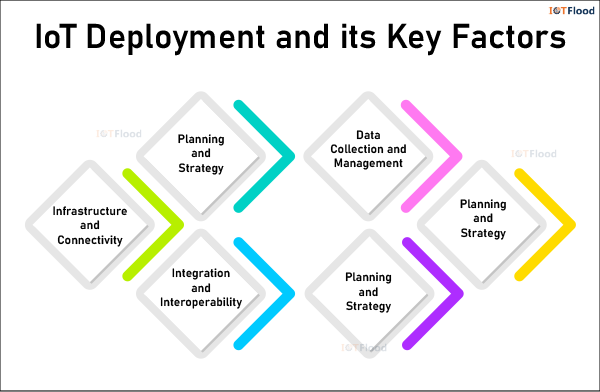
Organizations can successfully implement IoT solutions that yield observable advantages, such as increased customer satisfaction, cost savings, operational efficiency, and data-driven insights for well-informed decision-making, by adhering to these guidelines and considerations.
Large-scale IoT deployment in businesses
Businesses that want to adopt IoT on a large scale must take into account a number of strategic factors in order to successfully execute the technology across departments, locations, and use cases. Here’s a summary of the general process large-scale enterprises use to implement IoT:
Identifying Use Cases and Objectives:
The first stage is to define specific use cases and goals for IoT deployment. This entails being aware of the problems facing the company, areas in which optimization can be achieved, and possible applications of IoT technology. Use cases can include supply chain optimization, asset tracking and monitoring, predictive maintenance, and improving the customer experience.
Strategic Planning and Roadmapping:
A large-scale IoT deployment necessitates a strategic roadmap outlining the scope, timing, budget, resources, and critical milestones. In order to coordinate IoT projects with overarching company goals and priorities, business units, operations, and IT departments work together during this planning phase.
Infrastructure Readiness:
For a large-scale IoT implementation, a solid infrastructure must be established. In order to do this, the appropriate IoT devices, sensors, gateways, and communication protocols must be chosen in accordance with the scalability and use case requirements. To handle and analyze data effectively, cloud-based IoT platforms and edge computing solutions are frequently utilized.
Data Management and Analytics:
Managing the massive amounts of data produced by IoT devices is crucial. Companies must put into practice data management plans that guarantee data security, privacy, compliance, and quality. IoT data is processed using advanced analytics tools and techniques, such as machine learning and artificial intelligence (AI) algorithms, to extract useful insights for decision-making.
Security and Compliance:
When it comes to extensive IoT adoption, security is crucial. Strong security measures must be put in place by businesses to guard against cyberattacks on IoT devices, networks, and data. This covers intrusion detection systems, access controls, encryption, authentication, and frequent security audits. Adherence to industry norms and laws, such HIPAA and GDPR, is also crucial.
Integration with Existing Systems:
For smooth data interchange and workflow automation, IoT solutions must be integrated with current company apps, databases, and IT systems. With the help of this integration, IoT data can be used throughout the company to improve visibility, productivity, and teamwork.
Pilot Testing & Validation:
To validate the IoT solution in real-world scenarios prior to full-scale implementation, firms frequently carry out proof-of-concept trials and pilot tests. This enables the deployment strategy to be optimized, performance assessed, and feedback gathered prior to a larger-scale rollout.
Scalability and Flexibility:
Large-scale IoT deployment necessitates scalability and flexibility to handle expansion, changing business needs, and technology improvements. Companies should use cloud services for elasticity, build IoT architectures that can grow both horizontally and vertically, and use modular strategies that make it simple to integrate new features and devices.
Training and Change Management:
For successful adoption, staff must receive training on IoT processes, technologies, and best practices. To guarantee a seamless transition and alignment with the objectives and organizational culture, change management techniques should be put into practice.
Continuous Monitoring and Optimisation:
After implementation, ongoing performance tracking, monitoring, and optimisation are required to make sure the IoT deployment produces the desired results. This entails keeping an eye on user input, system performance, data quality, device health, and iteratively improving as necessary.
Large-scale companies may successfully implement IoT solutions that spur innovation, increase operational effectiveness, improve customer experiences, and open up new revenue streams by taking these actions and factors into account.
LoRaWAN- Best Solution for Large-Scale IoT Deployments
LoRaWAN, or long-range wide area network, is highly regarded for being among the greatest options available for extensive Internet of Things installations because of its special features and capabilities. It can link a large number of IoT devices across long distances while saving energy since it works on the low-power, wide-area networking principle.
LoRaWAN is regarded as a great option for extensive IoT installations for the following main reasons:
Long Range Connectivity: LoRaWAN is perfect for applications that need connectivity over wide territories or even urban areas because it can cover enormous geographic areas. Because of its long range, fewer gateways are required, which simplifies the infrastructure needed for large-scale deployments.
Low Power Consumption: Because LoRaWAN networks consume very little energy, Internet of Things devices can run on battery power for long periods of time. When deploying devices in inaccessible or remote areas where it is not practical to replace batteries often, this capability is essential.
Scalability: Thousands to millions of devices can be supported by a single network infrastructure because to the great scalability of LoRaWAN networks. This scalability is critical for supporting the increasing number of IoT devices in large-scale deployments in various industries, including asset tracking, smart cities, agriculture, and industrial automation.
Cost-Effective Deployment: LoRaWAN deployments are economical because they can cover large areas with little infrastructure, use less power, which lowers operating costs, and make it easier to manage a large number of devices by using centralised network management platforms.
Secure Communication: Strong security features are built into LoRaWAN to guarantee the privacy, accuracy, and legitimacy of data transferred between gateways and devices. In large-scale IoT installations, this degree of security is essential for safeguarding sensitive data, particularly in industries like healthcare, banking, and smart infrastructure.
LoRaWAN is a great option for enterprises aiming to implement and oversee extensive IoT systems successfully due to its long-range connection, low power consumption, scalability, affordability, and security.
Challenges Faced in Large-Scale IoT Deployments
Numerous obstacles must be successfully addressed by organizations in order to ensure the successful implementation and operation of large-scale IoT deployments. Among the principal difficulties are:
Scalability: Increasing the number of devices, data volume, and user interactions that IoT solutions can support is one of the main issues. Ensuring the smooth operation of increasingly complex networks, devices, and data streams calls on scalable cloud or edge computing resources, reliable infrastructure, and effective communication protocols.
Interoperability: One major problem is ensuring interoperability among various IoT devices, platforms, and systems from various suppliers. In order to facilitate smooth integration and data interchange throughout the IoT ecosystem, standardization of communication protocols, data formats, and device management protocols is essential.
Data management: Effectively managing and processing enormous volumes of IoT data is a difficult undertaking. Effective data management techniques, such as procedures for data collecting, storage, processing, analytics, and governance, must be put into place by organizations. The complexity increases with the management of data security, privacy, and quality as well as regulatory compliance.
Security and privacy: Given the widespread use of connected devices and the potential risks they pose, Internet of Things security is a serious problem. Strong security mechanisms, such as encryption, authentication, access controls, secure firmware updates, and continuous monitoring, are needed to protect IoT devices, networks, and data against cyber attacks, unauthorized access, data breaches, and privacy violations.
Reliability and Performance: For mission-critical applications, guaranteeing the dependability, availability, and performance of IoT systems is essential. Issues with network connectivity, malfunctioning devices, latency, bandwidth limitations, and system outages can affect how well an IoT deployment performs overall and how well users interact with it.
Integration with Legacy Systems: Compatibility, data transfer, system integration, and workflow automation are among the obstacles associated with integrating IoT solutions with enterprise apps, infrastructure, and legacy systems that are currently in place. It’s possible that outdated systems don’t have the required standards or APIs to integrate with contemporary IoT devices easily.
Regulatory Compliance: Complying with industry rules, privacy legislation, and data protection laws (including GDPR, CCPA, and HIPAA) makes IoT deployments more complicated. Businesses need to make sure that the legal and regulatory standards pertaining to data security, privacy, consent management, data retention, and data sharing procedures are met by their IoT solutions.
Skill Gaps and Training: Professionals with experience in IoT device administration, data analytics, cybersecurity, cloud computing, and software development are needed due to the rapid proliferation of IoT technology. For IoT implementations to be effective, talent shortages must be filled, training must be sufficient, and internal skills must be developed.
Costs and ROI: Large-scale IoT deployments require large upfront investments in hardware, software, infrastructure, connectivity, security measures, and on-going maintenance. Organizations must carefully negotiate the problem of calculating and attaining a positive return on investment (ROI) while controlling costs and budget limits.
User Acceptance and Adoption: To fully realize the potential of IoT installations, it is imperative to ensure that users, consumers, or stakeholders, embrace, adopt, and engage with IoT solutions. Adoption and satisfaction can only be increased by offering user-friendly interfaces, personalized experiences, value-added services, and solutions for privacy and data security issues.
Over the course of IoT deployments, strategic planning, technology selection, risk management, regulatory compliance, talent development, stakeholder collaboration, and continuous improvement are all necessary components of an all-encompassing approach to addressing these difficulties.
Large-scale IoT Deployment failures
Here are a few instances of large-scale IoT implementation failures in the real world:
Target’s 2013 Security Breach:
In 2013, a breach in Target Corporation’s security allowed hackers to access the company’s network by way of a misconfigured HVAC system. Millions of customers were impacted by this incident, which was linked to weak security procedures and IoT device vulnerabilities. This underscores the dangers of IoT installations without strong cybersecurity protocols.
Amazon Key Vulnerabilities (2017):
Due to security flaws, Amazon Key, a service that permits delivery workers to enter residences to deliver packages, came under investigation. Concerns over the safety and privacy implications of such deployments were raised by researchers who discovered that the IoT-enabled smart lock system was susceptible to hacking.
Stuxnet Attack on Industrial Control Systems (2010):
The industrial control systems of Iran’s nuclear plants, which were Internet of Things-enabled for remote monitoring and control, were the focus of the Stuxnet malware attack. The hack caused actual harm by taking advantage of these systems’ vulnerabilities, underscoring the possible repercussions of IoT security lapses in vital infrastructure.
Mirai Botnet Attack (2016):
This botnet attack used routers and cameras, among other unsecured Internet of Things (IoT) devices, to perform distributed denial-of-service (DDoS) attacks against websites and internet services. Millions of consumers’ ability to access the internet was affected by this attack, highlighting how crucial it is to secure IoT devices from being used maliciously.
Samsung’s SmartThings Vulnerabilities (2015):
A well-known IoT ecosystem for smart home devices, Samsung’s SmartThings platform, has security flaws that give hackers access to and control over linked devices without authorization. These flaws sparked worries about possible threats to user safety and privacy as well as the general security of IoT networks.
These illustrations draw attention to the difficulties and dangers that come with extensive IoT installations, such as privacy issues, cybersecurity flaws, problems with regulatory compliance, and possible effects on vital infrastructure and user safety. To reduce these dangers and make sure that large-scale IoT deployments are operated safely and effectively, organizations and legislators must place a high priority on strong security measures, frequent updates, openness, and accountability.
Solutions for Implementing Successful Large-Scale ioT deployments
Large-scale IoT deployments must be implemented successfully through a thorough strategy that takes into account a variety of issues and includes workable solutions. The following are important fixes for extensive IoT deployments:
Robust Security Measures: To safeguard IoT devices, networks, and data from cyber attacks, put in place strong security measures like encryption, authentication, access controls, secure firmware updates, and frequent security audits.
Scalable Infrastructure: Construct an infrastructure that is scalable to handle the increasing volume of data, number of IoT devices, and user interactions. To manage growing workloads and data processing needs, make use of scalable architectures, edge computing, and cloud services.
Interoperability Standards: Comply with interoperability standards and protocols to guarantee smooth data interchange and seamless integration between various IoT platforms, systems, and devices from various manufacturers.
Data Management and Analytics: Create effective data management plans for gathering, storing, processing, evaluating, and displaying Internet of Things data. To gain useful insights and enhance decision-making, make use of AI algorithms, machine learning, and sophisticated analytics technologies.
Compliance and Privacy: To preserve user data, uphold confidence, and reduce legal risks related to data security and privacy violations, make sure you are in compliance with industry standards, data protection laws, and privacy requirements (such as GDPR, HIPAA).
Integration with Legacy Systems: To facilitate smooth data interchange, workflow automation, and cooperation, integrate IoT solutions with current legacy systems, corporate apps, and infrastructure via APIs, middleware, and standard protocols.
Continuous Monitoring and Optimisation: To guarantee the dependability, accessibility, and efficiency of IoT systems, put performance monitoring, continuous monitoring, and optimisation techniques into effect. Deal with problems as soon as possible, make the most use of the resources available, and keep improving for increased effectiveness.
Training and Skill Development: To improve stakeholders’ and employees’ comprehension of IoT technology, security protocols, best practices, and compliance needs, offer training and skill development programmes.
User Experience Enhancement: Design intuitive interfaces, personalized services, and value-added features that improve end users’ usability, accessibility, and satisfaction with the product.
Collaboration and Partnerships: To trade expertise, share best practices, solve shared difficulties, and spur innovation in large-scale IoT deployments, cultivate partnerships with industry partners, technology suppliers, regulatory bodies, and standards organizations.
Organizations may overcome obstacles and reap the rewards of extensive IoT deployments by putting these ideas into practice and taking a strategic, all-encompassing approach. This will also open up new avenues for innovation, growth, and competitive advantage.
Successful Large-Scale IoT Deployments
Here are a few instances of large-scale IoT implementations that have been effective in various industries:
Smart Cities Initiatives:
- Singapore Smart Nation: As part of its Smart Nation program, Singapore has put a variety of IoT solutions into practice. This includes smart energy grids for effective energy management, smart parking systems, environmental monitoring for air and water quality, and real-time data for buses and trains.
- Songdo International Business District, South Korea: Songdo is a planned smart city in South Korea that uses IoT technologies to promote sustainable urban development. It includes cutting-edge healthcare facilities, intelligent waste management, connected transportation systems, and IoT-enabled buildings with energy-efficient systems.
Manufacturing and Industry 4.0:
- Bosch Connected Industry: Bosch’s Industry 4.0 strategy includes the implementation of IoT technologies in all of its manufacturing facilities worldwide. Predictive maintenance, asset tracking, quality assurance, and manufacturing process optimization are all made possible by IoT sensors and data analytics, which boost productivity and decrease downtime.
- General Electric’s Brilliant Factory: GE’s Brilliant Factory program turns its production facilities into smart factories by utilizing robotics, IoT devices, and AI-powered analytics. This covers predictive maintenance to prevent malfunctions, real-time equipment monitoring, and production schedule optimization for more efficient use of resources.
Healthcare & Telemedicine:
- Proteus Digital Health: Proteus is a company that creates Internet of Things-enabled digital medications, such as tablets with edible sensors. These sensors send information to wearable technology, which enables medical professionals to remotely watch vital signs and keep an eye on patients’ compliance with prescription schedules—thereby enhancing patient outcomes.
- Philips Healthcare: For connected medical devices, telemedicine consultations, and remote patient monitoring, Philips has implemented Internet of Things solutions in healthcare settings. This makes it possible for medical staff to provide individualized treatment, keep an eye on chronic illnesses, and take preemptive measures based on data collected in real time.
Agriculture and Agritech:
- John Deere’s Precision Agriculture: John Deere uses Internet of Things technology to help farmers with precision farming. In order to achieve optimal crop yields and resource efficiency, this includes IoT-enabled tractors and equipment with GPS and sensor data for precision planting, irrigation, fertilization, and crop monitoring.
- Granular (a Cortiva Agriscience Company): Granular provides IoT solutions for farm management, such as field sensors, weather monitoring, and data analytics. Crop management and yield optimisation can be achieved by farmers through data-driven decision-making, soil health monitoring, and irrigation schedule optimisation.
Smart Energy and Utilities:
- Enel’s Smart Grids: To update its infrastructure, the energy utility firm Enel has implemented IoT-enabled smart grids. This involves the integration of renewable energy sources for sustainable power generation, load balancing via grid optimization, and real-time monitoring of energy consumption through smart meters.
- Siemens Energy’s Grid Diagnostic Suite: With its Grid Diagnostic Suite, Siemens Energy provides Internet of Things solutions for utilities. In order to guarantee dependable and effective energy distribution, it consists of Internet of Things (IoT) sensors placed on power grids to identify defects, forecast equipment breakdowns, and optimize maintenance schedules.
These illustrations show the wide range of ways that IoT technology may be used to provide more intelligent, effective, and sustainable solutions for a variety of industries, demonstrating the possibility of a profoundly revolutionary effect.
Techniques Employed by Successful Large-Scale IoT Deployments
The aforementioned prosperous businesses have employed a range of tactics to guarantee the success of their extensive IoT rollouts. Here are some crucial tactics that these businesses employ:
Strategic Planning and Roadmapping:
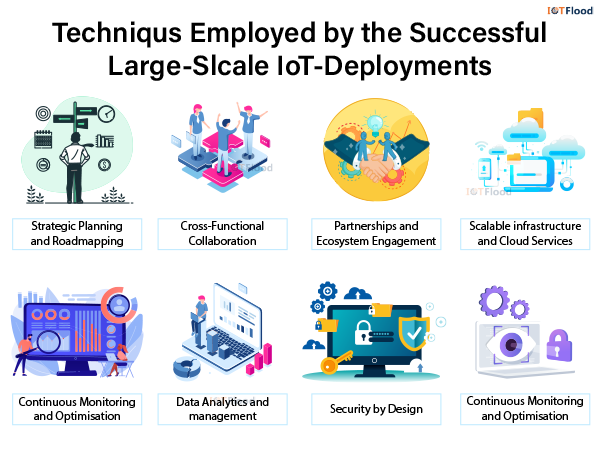
Organizations utilize strategic planning to establish precise goals, rank use cases, and develop an IoT implementation roadmap. This entails coordinating IoT projects with organizational objectives, evaluating the technology needed, projecting expenses, and establishing deployment schedules.
Cross-Functional Collaboration:
Successful IoT installations require cooperation between several departments, including IT, operations, R&D, marketing, and finance. In order to determine use cases, resolve technological issues, assign resources, and guarantee conformity with organizational priorities, cross-functional teams collaborate.
Partnerships and Ecosystem Engagement:
Businesses frequently work together with IoT platform providers, system integrators, technology partners, and industry experts to take use of their knowledge, have access to specialized tools and solutions, and shorten implementation schedules. Companies may stay current on industry trends, standards, and best practices by interacting with IoT ecosystems.
Scalable Infrastructure and Cloud Services:
Creating a scalable infrastructure is critical for supporting the growing number of IoT devices and data volume. Businesses use cloud services like AWS, Azure, or Google Cloud to get IoT platform features, scalable storage, and computational capacity. In order to obtain real-time insights and minimize latency, edge computing technologies are also utilized to process data closer to the source.
Data Analytics and Management:
Getting useful insights from IoT data requires efficient data management. Businesses use AI models, machine learning algorithms, and data analytics tools to examine massive information, find trends, forecast patterns, and make data-driven choices. Data security, privacy, and regulatory compliance are all guaranteed by data governance procedures.
Security by Design:
When deploying IoT, security is of utmost importance. To safeguard IoT devices, networks, and data from cyber attacks, businesses deploy security solutions including encryption, authentication, access controls, secure firmware updates, and frequent security audits. They also carry out vulnerability assessments, risk assessments, and personnel security training.
User-Centric Design:
Businesses concentrate on creating intuitive user interfaces and experiences for Internet of Things products. To make sure that IoT apps are clear, accessible, and beneficial to end users, they collect user input, carry out usability testing, and refine their designs. Features that allow for personalization and customization improve customer pleasure and engagement.
Continuous Monitoring and Optimisation:
Following deployment, businesses keep a close eye on IoT systems to assess performance, spot irregularities, and streamline workflows. They discover areas for improvement, obtain real-time insights, and apply optimizations to improve efficiency, reliability, and scalability using dashboards, analytics platforms, and monitoring tools.
Companies may overcome obstacles, get the most out of IoT installations, and boost innovation, productivity, and competitiveness in their specific markets by using these tactics.
Future Prospects
Large-scale IoT deployment solutions have extremely attractive future possibilities due to ongoing technological breakthroughs and rising demand for interconnected systems. The creation of more complex machine learning and data analytics algorithms is one major area of focus. With the help of these developments, businesses will be able to glean deeper insights from data created by the Internet of Things, which will improve operational efficiency and result in more precise forecasts and proactive decision-making.
The confluence of IoT with cutting-edge technologies like edge computing, 5G networks, and artificial intelligence (AI) is another area that is expected to flourish in the future. Many IoT devices will be able to connect seamlessly because of 5G networks’ quicker data throughput, reduced latency, and larger network capacity. Real-time data processing and analysis at the network edge will be made possible by edge computing, which will lessen dependency on centralized cloud servers and improve responsiveness for vital applications.
Large-scale IoT deployments will also continue to place a high premium on data security and privacy. To safeguard sensitive IoT data and uphold stakeholder trust, organizations will invest in strong security measures including blockchain technology, encryption, and sophisticated authentication processes. Furthermore, adhering to industry norms and legal regulations will continue to be crucial in fostering innovation in safe IoT systems.
As a result, there is great promise for innovation, increased productivity, and industry-wide transformation in large-scale IoT deployment solutions. Through adopting cutting-edge technologies, tackling security issues, and utilizing tactical alliances, institutions may create a networked, intelligent, and environmentally conscious future driven by the Internet of Things.
Conclusion
Extensive Internet of Things implementations mark a critical turning point in the development of digital infrastructure, with the potential to revolutionize numerous industries. The foundation of success is strategic planning, which helps businesses define specific goals and match IoT projects with larger corporate objectives. In addition to supporting the Internet of Things’ exponential expansion, scalable architectures promote agility, allowing for easy integration with current systems and future-proofing against technical obsolescence. Strong security protocols, which protect sensitive data and lessen cyber threats, promote trust and confidence in IoT ecosystems. These protocols include end-to-end encryption, access limits, and frequent audits.
Moreover, the incorporation of sophisticated analytics methodologies enables establishments to derive meaningful conclusions from extensive amounts of data created by the Internet of Things. Proactive decision-making, predictive maintenance, and customized customer experiences are made possible by machine learning and predictive analytics algorithms, which boost competitiveness and operational efficiency. Adopting best practices for device administration, like remote monitoring, automated provisioning, and firmware updates, simplifies processes and maximizes resource use, which reduces costs and improves scalability.
A holistic strategy that takes sustainability and lifecycle management into account is essential as enterprises negotiate the challenges of large-scale IoT deployments. Sustainable IoT ecosystems lower carbon footprints and encourage environmental stewardship through the adoption of energy-efficient protocols, the implementation of appropriate end-of-life disposal processes, and adherence to environmental regulations. Organizations may ultimately realize the full potential of IoT to drive digital transformation, improve consumer experiences, and create value in the always changing digital landscape by embracing innovation, cooperation, and continuous improvement.