Challenges in Managing and Scaling IoT Devices
The development of Internet of Things devices is evidence of how quickly technology is advancing. IoT devices have progressed from simple sensors and actuators used mainly for monitoring and control in industrial settings to complex, networked systems with a broad range of uses. As the Internet of Things became more widely adopted, smart home appliances such as voice assistants, lighting, and thermostats became commonplace. This change laid the groundwork for more sophisticated applications in healthcare, agriculture, transportation, and urban infrastructure, in addition to improving convenience.
IoT devices are being used in a wide range of industries, and each one is utilising data analytics and connectivity to boost productivity and creativity. IoT devices in healthcare enable personalised treatment regimens, remote patient monitoring, and predictive maintenance of medical equipment. IoT sensors are used in agriculture to automate farming procedures, monitor crop health, and optimise irrigation. The implementation of predictive maintenance techniques, asset management, and improved supply chain visibility are among the ways industries benefit from IoT. Smart cities use IoT to manage waste, transportation, energy, and public safety, enabling sustainable urban growth. These many uses highlight how IoT devices can completely transform industries and enhance people’s quality of life. IoT has impacted nearly every facet of contemporary life, from wearable technology and smart homes to industrial machines and smart cities.
But as IoT devices proliferate quickly, there are several difficulties in properly controlling and scaling these networked systems. This article discusses the potential challenges of scaling and managing IoT devices.
Understanding IoT Devices
Physical items integrated with software, sensors, and networking capabilities that allow them to gather and share data with other systems and devices online are known as Internet of Things (IoT) devices. These gadgets might be as basic as temperature sensors or motion detectors, or as sophisticated as machines with built-in computers.
IoT devices are unique because of their capacity for autonomous decision-making, communication, and interaction, depending on the data they collect. This results in enhanced automation, efficiency, and connectivity across a range of disciplines.
The idea of a linked ecosystem, in which humans, machines, and processes are all seamlessly integrated to gather data, make choices, and produce meaningful results, is fundamental to the Internet of Things. By offering real-time data monitoring, analysis, and control, they are essential to the development of intelligent environments, including smart cities, smart homes, and innovative industries. The range and capabilities of IoT devices expand as the IoT ecosystem evolves, creating new opportunities for creativity and game-changing solutions across a variety of industries.
Why are they used?
IoT devices have a wide range of applications due to their unique features and advantages.
Data Collection and Monitoring: Internet of Things (IoT) devices can collect data from their connected processes, equipment, and surroundings. This data collection enables real-time monitoring of conditions, performance indicators, and trends, providing insightful information for decision-making.
Automation and Control: Using preset rules or algorithms, Internet of Things devices can automate certain operations. Smart thermostats, for instance, can adjust temperature settings in response to occupancy and external factors, and industrial Internet of Things (IoT) devices can control equipment and procedures to achieve maximum efficiency.
Efficiency and Optimisation: IoT devices aid in resource optimisation, energy efficiency improvements, downtime reduction, and overall operational efficiency by gathering and analysing data across a variety of industries, including manufacturing, energy management, transportation, and agriculture.
Remote Access and Management: With IoT devices, users can monitor and manage systems and devices from any location with an internet connection. This remote access enhances ease of use, makes troubleshooting easier, and encourages preventative maintenance.
Improved User Experience: The Internet of Things (IoT) enhances user experience in consumer applications such as wearable technology and smart homes by providing personalised services, seamless device connectivity, and automated repetitive tasks, all of which increase comfort and convenience.
Innovation and New Services: Because it enables the creation of new services and business models, IoT promotes innovation. Predictive maintenance services, for instance, enabled by IoT technology, provide proactive equipment repair based on real-time data analysis, reducing costs and improving reliability.
Data-driven decision-making: Analysing data from Internet of Things devices can yield valuable insights, guide decision-making, and drive ongoing development across a range of sectors and applications.
All in all, IoT devices are essential to contemporary digital ecosystems across the commercial, industrial, residential, and societal sectors, as they promote efficiency, automation, connectivity, innovation, and data-driven decision-making.
Types of IoT Devices
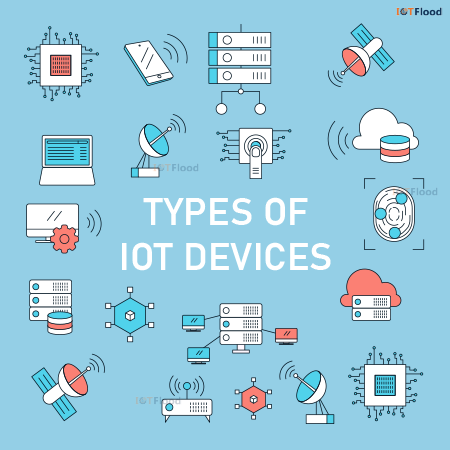
IoT devices come in a variety of forms, each with a distinct function and supporting various markets and uses. Here are a few typical IoT device types:
Sensors: They are the basic IoT devices that detect and measure physical characteristics, including temperature, humidity, light, motion, pressure, and sound. They are employed in many different applications, including industrial automation and environmental monitoring.
Actuators: Internet of Things devices that convert electrical signals into motion. They are employed to operate systems or devices remotely, such as turning appliances on and off, varying motor speeds, and opening and closing valves.
Smart Home Devices: Designed for domestic use, these Internet of Things appliances improve comfort, convenience, and energy economy. Voice assistants, security cameras, smart locks, intelligent lighting systems, and thermostats are a few examples.
Wearable Devices: Wearable Internet of Things (IoT) devices track activities and gather data on fitness, health, and other topics. They are worn on the body. Smartwatches, fitness trackers, medical monitoring equipment, and augmented reality glasses are a few examples.
Industrial IoT (IIoT) Devices: IIoT devices are used in industrial settings to facilitate predictive maintenance, monitor equipment performance, and increase operational efficiency. They consist of PLCs (Programmable Logic Controllers), actuators, industrial sensors, and SCADA (Supervisory Control and Data Acquisition) systems.
Connected Vehicles: Internet of Things (IoT) devices in linked cars collect and send data for telematics, driver assistance, diagnostics, and navigation. These gadgets consist of communication modules, onboard sensors, and GPS trackers.
In the energy sector, demand-response mechanisms are enabled, grid operations are managed, and electricity consumption is monitored via IoT devices, also referred to as smart grid devices. Energy management systems, smart meters, and grid sensors are a few examples.
Healthcare IoT Devices: These gadgets are utilised in telemedicine, medication management, medical diagnostics, and remote patient monitoring. Medical sensors, linked medical equipment, wearable health monitors, and telehealth platforms are a few examples.
Agricultural IoT Devices: To maximise farming techniques and resource efficiency, IoT devices in agriculture track crop health, weather patterns, soil conditions, and irrigation systems. Drones, automated irrigation systems, weather stations, and soil moisture monitors are a few examples.
Smart City Infrastructure: Internet of Things (IoT) devices help with public safety, transportation, urban management, and environmental monitoring in smart cities. Air quality monitors, bright lighting, waste management systems, traffic sensors, and security cameras are a few of them.
These are only a few examples, and the number of IoT devices continues to grow as technology progresses and new applications arise across businesses and sectors.
Applications of IoT devices
IoT devices are used in a wide range of sectors and businesses, fostering creative thinking, increasing productivity, and improving user experiences.
The following are some important uses for IoT devices:
Smart Homes: Smart lighting systems that adjust brightness based on occupancy or natural light, voice-activated assistants for convenient home automation, smart security cameras and door locks for enhanced home security, and smart thermostats for energy-efficient heating and cooling are just a few uses of Internet of Things devices in smart homes.
Healthcare: IoT devices include medication adherence systems that remind patients to take their medications, wearable health trackers that monitor vital signs and activity levels, medical equipment with IoT capabilities for real-time data monitoring, and telemedicine platforms for remote consultations and diagnosis.
Industrial Automation: Industrial Internet of Things (IIoT) devices are used in manufacturing, logistics, and utilities for supply chain optimisation, energy management systems, real-time production process monitoring, asset tracking and management, and predictive maintenance of machinery.
Agriculture: GPS-enabled tractors and farming equipment, weather stations for weather monitoring, drones for aerial crop surveillance, smart greenhouses with automated climate control, and livestock monitoring systems are just a few examples of IoT devices used in agriculture.
Smart Cities: Smart city initiatives heavily rely on IoT devices for functions such as traffic flow and congestion monitoring, parking space management, optimising public transportation systems, energy-saving bright street lighting, waste management systems with bin sensors for effective collection, and public safety enhancements through surveillance cameras and emergency response systems.
Energy Management: Demand-response programmes that adjust energy use based on supply and demand, intelligent grid monitoring, home energy monitoring systems that track electricity consumption, and IoT-enabled monitoring and control of renewable energy systems such as solar panels and wind turbines are all enabled by IoT devices.
Retail and Marketing: IoT-enabled payment systems for smooth transactions, smart shelves that analyse consumer behaviour and preferences, inventory management systems with RFID tags and sensors for real-time tracking of merchandise, and personalised marketing campaigns based on customer data and analytics are just a few examples of IoT devices in the retail industry.
Transportation and Logistics: Temperature and humidity sensors for cold chain logistics, warehouse automation systems, GPS tracking for real-time location updates and route optimisation, vehicle telematics for fleet management, and supply chain visibility platforms for end-to-end tracking of goods are just a few examples of IoT devices in transportation and logistics.
These uses demonstrate how adaptable and powerful IoT devices are in a variety of fields, fostering innovation, sustainability, and higher standards of living.
Understanding the Complexity of IoT Devices
The unique nature of IoT devices, the scale of deployments, and the dynamic nature of IoT ecosystems all contribute to the complexity of managing them. Device heterogeneity, which requires integrating and maintaining a broad range of devices with different capabilities, communication protocols, and security features, is a significant challenge. To ensure smooth connections and data sharing across diverse devices, organisations must address interoperability challenges.
Another crucial component of managing IoT devices is scalability, particularly in large-scale deployments where dozens or even millions of devices may be linked together. It isn’t easy to provision, monitor, and uphold uniform performance and security requirements throughout the fleet when there are so many devices to manage. The need for real-time data processing and analytics, which demands robust infrastructure and data management practices, exacerbates this scaling issue.
Perhaps the most essential issue with IoT device management is security. Because of their interconnectivity and potential weaknesses, Internet of Things (IoT) devices are frequently targets of cyber threats. Strong authentication procedures, encryption standards, access controls, and ongoing monitoring for unusual or suspect activity are all necessary to ensure end-to-end security. Organisations must implement proactive security measures and keep up with the most recent security practices and standards due to the dynamic nature of security threats. This will help them manage risks effectively.
IoT device lifecycle management, including maintenance, decommissioning, upgrades, provisioning, and configuration, adds complexity. Adherence to industry standards and best practices, automation technologies, and comprehensive strategies is necessary for the effective management of various lifecycle stages. In general, enterprises must grasp and navigate the complexity of IoT device management to fully utilise IoT technologies, minimise risks, and ensure optimal performance and security.
Why is IoT device management getting complex over time?
The management of IoT devices is becoming increasingly complex due to numerous interrelated issues. The quick spread of IoT devices across many sectors and domains is one of the leading causes. Managing an increasing number and variety of connected devices is becoming increasingly difficult, necessitating complex management systems to handle a wide range of device types, protocols, and capabilities.
IoT devices also frequently operate in diverse network architectures, communication protocols, and data formats. Device management activities, including provisioning, configuring, monitoring, and maintenance, are made more difficult by this heterogeneity. It is imperative to standardise device management procedures to ensure compatibility, optimise workflows, and improve overall system performance.
The lifecycle management of IoT devices further complicates device management procedures. From deployment to decommissioning, managing devices involves addressing end-of-life issues, security patches, firmware updates, and device health monitoring. Managing device lifetime stages and facilitating smooth transitions become essential for preserving IoT projects’ optimal performance, security, and scalability as IoT ecosystems and devices age.
How is Scalability an issue in IoT?
With so many devices connected and the data they generate growing exponentially, scalability is a significant challenge in the Internet of Things. The challenge of supporting a large number of devices while maintaining adequate performance grows as IoT ecosystems grow. The ability of Internet of Things networks to manage a large number of devices with ease, guaranteeing dependable connectivity, data transfer, and reaction times throughout the network, is one facet of scalability.
The variety of devices found in Internet of Things environments, such as different sensors, actuators, wearables, and smart appliances, presents another challenge to scalability. Since devices can vary in processing power, data formats, and communication protocols, it might not be easy to integrate and grow the ecosystem as a whole efficiently. Scalability efforts are further complicated by compatibility issues, data interoperability, and resource constraints, necessitating reliable solutions for the effective management of heterogeneous device ecosystems.
Scalability in IoT also applies to analytics and data management. It may become increasingly complex for conventional data processing and storage techniques to manage the enormous influx of real-time IoT data as the volume, velocity, and variety of IoT-generated data continue to rise. To handle and extract insights from massive IoT data streams, scalable data processing frameworks, cloud-based solutions, edge computing capabilities, and effective data analytics techniques are necessary.
Moreover, scaling issues in IoT are made worse by privacy and security concerns. The attack surface for vulnerabilities and cyber threats grows as the number of connected devices increases. Scalability planning is crucial for ensuring scalable security mechanisms, such as threat detection, access control, encryption, and authentication, across an extensive, dynamic Internet of Things network. To properly support the growth and evolution of IoT ecosystems, addressing these scaling concerns requires a comprehensive approach that considers network infrastructure, device diversity, data management, analytical capabilities, and robust security measures.
The Intricacies of Scale: Challenges in Managing and Scaling IoT Devices
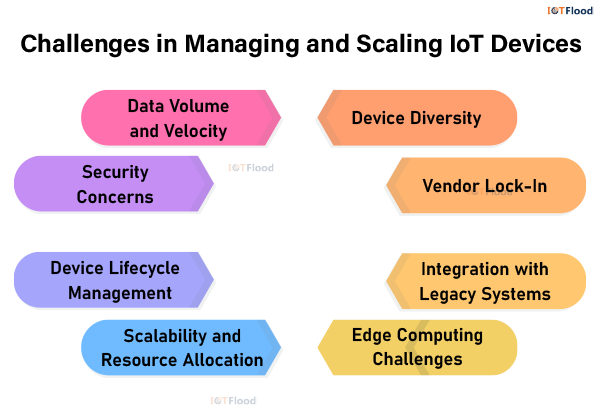
To maintain effective operations and peak performance, enterprises need to overcome a variety of issues associated with managing and growing IoT devices. The following are some of the main complexities and difficulties in scaling and administering IoT devices:
Device Diversity: A wide range of devices from various manufacturers with differing capabilities, communication protocols, and security standards are frequently included in IoT ecosystems. Strong compatibility frameworks and interoperability standards are necessary to manage this variability.
Data Volume and Velocity: In real time, IoT devices produce enormous volumes of data. Robust data processing pipelines, scalable data storage solutions, and efficient data governance techniques are needed to handle this influx of data effectively.
Security Concerns: Unauthorised access, data breaches, and malware assaults are just a few of the security risks that Internet of Things devices are susceptible to. Robust authentication, encryption, and intrusion detection systems are essential for managing and protecting a large number of devices spread across multiple networks and locations.
Device Lifecycle Management: The provisioning, deployment, monitoring, maintenance, and decommissioning phases of an IoT device’s lifecycle are intricate. To optimise device performance and longevity, efficiently managing these stages requires fewer procedures, automated workflows, and lifecycle analytics.
Scalability and Resource Allocation: Resource allocation becomes crucial as Internet of Things deployments grow in size. Optimal performance and cost-effectiveness are ensured across the IoT infrastructure by balancing resource utilisation, bandwidth management, and scalability.
Edge Computing Challenges: As the number of edge devices in IoT deployments grows, managing distributed computing resources, ensuring low-latency data processing, and maintaining consistency across edge nodes become increasingly complex.
Compliance and Regulation: Cybersecurity standards, industry rules, and data privacy legislation must be followed by IoT installations. Ensuring regulatory compliance across a variety of IoT scenarios requires robust policies, auditing procedures, and risk management techniques.
Integration with Legacy Systems: Many businesses combine IoT solutions with existing legacy systems. This creates compatibility issues, data integration headaches, and interoperability problems that must be resolved to ensure smooth operation and data flow.
Vendor Lock-In: Reliance on a single supplier for Internet of Things solutions may lead to vendor lock-in, limiting adaptability, scalability, and innovation. The risks associated with vendor lock-in are reduced by maintaining vendor relationships, using open standards, and fostering a vendor-agnostic mindset.
Cost management: Purchasing devices, maintaining connectivity, upgrading infrastructure, maintaining security, and other associated expenditures are all part of scaling IoT projects. Long-term sustainability depends on efficient cost management techniques, including ROI analysis, predictive maintenance, and resource optimisation.
Complexity of Device Provisioning: The initial setup and configuration procedure can be difficult and time-consuming when deploying IoT devices at scale. Security credentials, network connectivity parameters, and unique IDs must be provisioned for every device. Manually setting up hundreds or thousands of devices can be a laborious and error-prone task. The deployment process must be streamlined by automating it.
Data Overload and Analytics: Large volumes of data are produced by IoT devices frequently in real time. It can be complicated to manage and analyse this data, particularly when working with numerous devices. Robust analytics capabilities and scalable infrastructure to manage the volume, velocity, and variety of data generated are necessary to extract relevant insights from IoT data.
Firmware and Software Updates: Updating the firmware and software of Internet of Things devices is essential for fixing security flaws, enhancing functionality, and adding new features. On the other hand, updating a large number of devices across several sites can be a difficult, time-consuming task. It’s challenging to provide safe, easy updates while causing the least possible interference with device functionality.
Organisations can improve the administration and scalability of their IoT devices and realise the full potential of IoT technology to spur innovation, efficiency, and value creation by proactively addressing these complexities and challenges.
Real-world examples that illustrate the consequences of Poor IoT Device Management and Scaling
The repercussions of inadequate IoT device management and scaling are demonstrated by numerous real-world examples, underscoring the need to address these issues efficiently. Here are a few noteworthy examples:
Mirai Botnet Attack (2016)
This botnet attack exposed the weaknesses of mismanaged Internet of Things devices. A vast botnet of IoT devices, including routers and cameras, was created by the assault, which exploited default or weak passwords. This botnet was then used to perform distributed denial-of-service (DDoS) attacks. Strong device security procedures, such as frequent firmware updates, reliable authentication methods, and appropriate credential management, are necessary, as this instance demonstrated.
Ring Camera Hacks
Weak passwords and inadequate security procedures have enabled hackers to compromise Ring security cameras on numerous occasions. These cameras were compromised by hackers who obtained unauthorised access, violating users’ privacy and casting doubt on the security of IoT devices in smart home settings. These events highlight the dangers of inadequate device management and underscore the importance of providing Internet of Things devices with robust authentication and encryption mechanisms.
Hospital Cyber Attack (2017)
An IoT-connected medical device was among the many systems affected by a cyberattack that struck a hospital in the United States. The hack caused service interruptions and may have put patient safety at risk by exploiting flaws in outdated software and inadequate security procedures. This occurrence highlights the importance of IoT device security in hospital settings, where patient safety and health depend on a dependable, secure IoT infrastructure.
Smart City Vulnerabilities
IoT device security and administration issues have been a problem for some innovative city projects. For instance, bad actors may exploit flaws in traffic control systems, bright street lights, or environmental monitoring equipment to compromise public safety, disrupt city services, or collect private information. These weaknesses underscore the need for secure-by-design principles, regular security assessments, and robust cybersecurity procedures in IoT deployments for smart cities.
Industrial IoT Breaches
In industrial environments, inadequate IoT device management can cause significant disruptions and security breaches. For example, a cyberattack on insecure IoT devices on the production floor might cause a manufacturing plant to go offline. Similarly, insufficient IoT device management practices can disrupt essential infrastructure sectors such as energy, transportation, and utilities, underscoring the importance of cybersecurity resilience in industrial IoT installations.
These illustrations highlight the practical consequences of ignoring scaling and IoT device management. Essential actions to reduce the risks associated with IoT installations include implementing strong security measures, adopting best practices for device lifecycle management, ensuring updates and patches are applied regularly, and prioritising cybersecurity in the IoT strategy.
Strategies for Addressing IoT Device Management and Scalability Challenges
IoT device management and scalability issues call for an all-encompassing strategy that includes organisational tactics, technology, and processes. The following are some essential tactics to address these issues successfully:
Robust Device Lifecycle Management
- To speed up device onboarding and deployment, automate provisioning and setup.
- Use device management platforms that provide software upgrades, centralised maintenance, and monitoring for all IoT devices.
- To guarantee data security and regulatory compliance, clearly define policies and procedures for device retirement, disposal, and end-of-life management.
Enhanced Security Measures
- To prevent unauthorised access, use robust authentication techniques such as certificate-based and multi-factor authentication (MFA).
- To safeguard sensitive data, encrypt it both while it’s in transit and at rest using industry-standard encryption techniques.
- To fix security flaws and ensure devices use the latest patches, regularly audit and update firmware and software.
- Use security analytics tools and intrusion detection systems (IDSs) to identify and address potential security risks quickly.
Scalable Infrastructure and Resource Management
- Distribute computer resources and handle data processing closer to the source by utilizing edge computing technologies and cloud-based IoT platforms.
- To handle the growing volume of IoT data, use scalable storage options such as distributed databases or object storage.
- Utilise traffic management and network segmentation strategies to maximise bandwidth utilisation and guarantee effective data transfer.
Interoperability and Standardisation
- Respect industry IoT communication standards and protocols to enable smooth integration and interoperability between devices from various suppliers.
- Invest in Internet of Things solutions that encourage ecosystem flexibility and minimise vendor lock-in by supporting open standards and protocols.
- Participate in standardisation initiatives and industry consortia to help develop interoperable Internet of Things frameworks.
Data Governance & Analytics
- To specify data ownership, access restrictions, data preservation, and privacy compliance requirements, create strong data governance policies.
- Utilise machine learning techniques and data analytics to maximise device performance, enable predictive maintenance, and extract valuable insights from IoT data.
- Establish procedures for data quality assurance to guarantee data consistency, accuracy, and completeness for well-informed decision-making.
Collaboration and Partnership
- Encourage cooperation across the security, operations, and IT departments, as well as outside vendors, to solve cross-functional problems and exchange best practices and strategies.
- To leverage their knowledge, support, and resources for managing IoT deployments, get in touch with partners in the IoT ecosystem, such as software developers, device makers, and service providers.
- To improve cybersecurity resilience, incident response skills, and threat intelligence, form alliances with cybersecurity companies and industry leaders.
Continuous Monitoring and Optimisation
- Use analytics dashboards and real-time monitoring tools to assess device performance, spot anomalies, and proactively identify potential issues.
- To identify opportunities for cost reduction, resource allocation improvements, and optimisation, conduct regular audits, assessments, and performance reviews.
- Continually assess and revise IoT policies, technologies, and strategies in light of changing organisational needs, legal constraints, and market trends.
By implementing these tactics, businesses can better handle IoT device management and scalability, ensuring safe, reliable, and effective IoT deployments across a range of use cases and sectors.
Future Prospects in Managing and Scaling IoT Devices
IoT device management and scalability are dynamic fields shaped by industry trends, technological breakthroughs, and evolving user requirements. Looking ahead, several significant developments and trends are shaping how IoT device management and scalability will grow, opening the door to creative solutions and enhanced features.
Edge Computing and Edge AI
The combination of edge computing and artificial intelligence (AI) technologies is set to transform IoT device management. By enabling real-time data processing at the edge of devices, edge computing reduces latency, bandwidth consumption, and reliance on centralised cloud servers. When AI algorithms are integrated with edge devices, they can enhance scalability and efficiency in Internet of Things installations by performing autonomous decision-making, predictive maintenance, and sophisticated analytics.
5G Connectivity
As 5G networks become widely adopted, they will likely offer greater capacity, reduced latency, and faster data transfer rates, opening new possibilities for controlling and growing IoT devices. Large-scale IoT deployments across a variety of industries are made possible by 5G, which provides dependable, high-bandwidth applications and seamless connectivity for a myriad of IoT devices.
Blockchain for IoT Security
Blockchain technology provides decentralised, immutable transaction processing and data storage, making it a perfect fit for boosting security in IoT ecosystems. Smart contracts, data integrity verification, and blockchain-based authentication can be used to strengthen security protocols, fend off cyberattacks, and build trust amongst IoT devices, stakeholders, and data exchanges.
AI-powered Automation
In IoT device management, automation is driven by AI and machine learning algorithms. Automation technologies driven by AI can simplify tasks like device provisioning, configuration management, performance optimisation, and anomaly detection. This reduces the need for manual intervention, boosts operational effectiveness, and expands the scalability of Internet of Things deployments.
Interoperability Standards
To solve compatibility issues and encourage smooth integration in IoT ecosystems, industry-wide efforts to develop interoperability standards and protocols are essential. Standardisation efforts are driven by initiatives such as the Open Connectivity Foundation (OCF), IoTivity, and MQTT, which promote interoperability among IoT devices, platforms, and applications.
Advanced Data Analytics
Organisations can now extract meaningful insights from IoT data streams thanks to advances in data analytics, such as edge analytics, federated learning, and hybrid cloud solutions. Proactive decision-making, predictive maintenance, and optimisation of IoT device performance, scalability, and resource utilisation are made possible by predictive analytics, anomaly detection, and prescriptive recommendations.
Sustainable IoT Practices
Energy efficiency, resource optimisation, and minimising environmental impact are the main focuses of sustainable IoT projects, which are becoming increasingly popular. Energy-efficient IoT device deployments, the use of renewable energy sources, and the application of eco-friendly design principles all help to achieve sustainability objectives, save operating costs, and enable scalable, ecologically responsible IoT deployments.
Cybersecurity Innovations
To reduce cyber threats and guarantee data safety in IoT contexts, cybersecurity technologies such as zero-trust architectures, quantum-resistant encryption, and IoT security frameworks must constantly evolve. Strong security protocols, such as device attestation, secure firmware updates, and secure bootstrapping, improve the scalability, resilience, and reliability of IoT ecosystems.
Collaborative Ecosystems
Working together, industry players such as software developers, service providers, device makers, and regulators can solve interoperability issues, promote innovation, and make IoT deployments more scalable. Scalable, interoperable IoT solutions are enabled by open-source projects, industrial consortia, and cooperative partnerships that foster knowledge exchange, standardisation, and best practices.
Human-Centric Design
The future of IoT device management depends on adhering to human-centric design principles, which prioritise usability, accessibility, and user experience. Ensuring that IoT solutions meet evolving user expectations and demands requires designing intuitive interfaces, personalised interactions, and context-aware apps that enhance user acceptance, satisfaction, and scalability.
All things considered, technology convergence, ecosystem cooperation, security breakthroughs, sustainability efforts, and user-centric innovation characterise the future possibilities for controlling and scaling IoT devices. Organisations may overcome obstacles, seize new opportunities, and realise the full potential of IoT in driving digital transformation, operational efficiency, and corporate success by embracing these trends and leveraging emerging technologies.
Conclusion
To sum up, the difficulties in expanding and controlling IoT devices highlight the need for businesses to adopt a comprehensive strategy. This method takes into account long-term factors such as data management, scalability, and regulatory compliance, in addition to addressing urgent issues such as security and interoperability. Businesses can develop effective strategies to reduce risks and open the door to long-term growth and innovation in the IoT space by adopting a holistic approach to these issues.
Furthermore, managing the challenges of IoT administration and growth requires embracing best practices. This entails implementing stringent security measures, adopting standardised interoperability protocols, establishing effective data management plans, and adhering to evolving regulatory requirements. Organisations can improve productivity, simplify processes, and build robust IoT ecosystems that adapt to future opportunities and challenges by adhering to industry best practices.
In addition, utilising cutting-edge technologies such as edge computing, advanced analytics, and artificial intelligence can significantly enhance the capabilities of Internet of Things implementations. These technologies facilitate intelligent automation, predictive analytics, and real-time data processing, enabling organisations to gain actionable insights, maximise performance, and foster ongoing progress in their Internet of Things endeavours. In the area of IoT management and scalability, cultivating collaboration amongst stakeholders—including industrial partners, regulators, and cybersecurity experts—is also crucial to fostering a favourable environment for innovation, information exchange, and collective problem-solving.